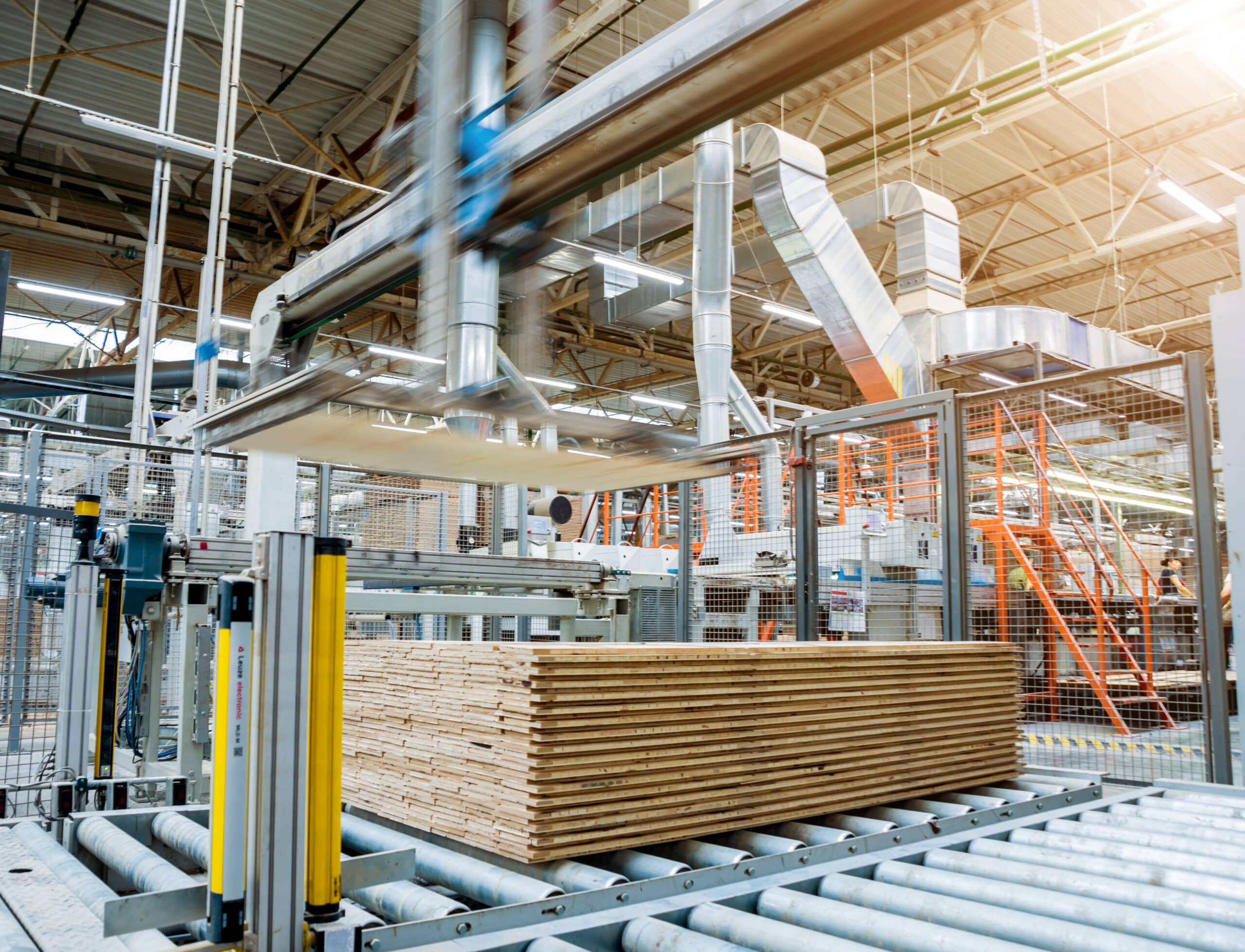
Stacking & De-Stacking
Eliminate Manual Handling Bottlenecks. Keep Your Lines Moving.
In high-production woodworking facilities, stacking and de-stacking are among the most physically demanding, injury-prone, and labor-intensive tasks on the floor. Whether you’re feeding raw boards into a processing line or organizing finished components at the end of one, manually moving, orienting, and staging wood products slows throughput, fatigues workers, and creates a persistent bottleneck that no amount of machine speed can overcome.
Mereen-Johnson engineers custom automated wood stacking and de-stacking systems purpose-built for the woodworking industry. From feeding rough lumber into a rip saw to precisely organizing finished door or flooring components for downstream handling, our robotic solutions eliminate the manual handling bottleneck and keep your production line running at its true capacity.
Key Benefits of Automated Wood Stacking & De-Stacking
- Consistent Production Flow — Robotic stacking and de-stacking systems maintain a steady, predictable material feed rate that manual handling simply can’t match across a full shift, let alone multiple shifts.
- Reduced Labor Costs & Dependency — Automate one of the most difficult positions to staff and retain, freeing your workforce for higher-value tasks and reducing exposure to skilled labor shortages.
- Fewer Injuries, Better Safety — Repetitive lifting, twisting, and carrying of heavy wood products is a leading cause of workplace injuries in manufacturing. Robotic stacking removes workers from these high-risk tasks entirely.
- Precise Part Orientation & Placement — Robotic systems place each board, panel, or component in the exact position and orientation required — eliminating misfeeds, misalignment, and the downstream quality problems they cause.
- Scalable for Multi-Shift & High-Volume Operations — Automated wood stacking systems don’t fatigue, slow down, or call in sick. They perform consistently across every shift, enabling higher throughput without adding headcount.
- Seamless Line Integration — Designed in-house by Mereen-Johnson’s own engineering team, our stacking and de-stacking systems are built to integrate cleanly with your existing machinery and material flow — not bolted on as an afterthought.
Robotic Stacking & De-Stacking Applications in Wood Manufacturing
Mereen-Johnson’s automated stacking and de-stacking solutions are engineered around the specific demands of wood products manufacturing — including the natural variability in board dimensions, surface texture, and weight that makes wood handling different from handling uniform manufactured goods.
Infeed De-Stacking for Processing Lines
Robotic de-stacking systems pull boards, panels, or blanks from a supply stack and feed them into your processing line — rip saws, moulders, tenoners, or other equipment — at consistent intervals and with precise orientation. This eliminates the manual labor required to stage and feed raw material, and keeps your machines running at full cycle rate without depending on an operator to keep pace.
Outfeed Stacking After Processing
After cutting, sizing, profiling, or finishing, components need to be collected, organized, and staged for the next step. Automated wood stacking at the outfeed handles this precisely — placing finished pieces into organized stacks by size, species, grade, or product type, ready for downstream handling, packaging, or shipping without manual sorting.
Between-Operation Buffering & Staging
In multi-step production lines, robotic stacking systems can act as intelligent buffers between operations — accumulating work-in-progress, organizing parts, and releasing them to the next station at the right rate to keep the overall line balanced and flowing.
Random-Width & Mixed-Dimension Handling
Wood manufacturing rarely involves perfectly uniform material. Mereen-Johnson’s stacking and de-stacking systems are designed to handle random-width boards, mixed lumber dimensions, and variable part geometries — using custom end-of-arm tooling and, where applicable, vision guidance to accommodate the natural variability of wood products.
Grade Sorting & Selective Stacking
When combined with Mereen-Johnson’s vision scanning capabilities, robotic stacking systems can sort and stack components by grade, defect status, or quality tier — automatically directing acceptable parts to production stacks and flagging or diverting rejects, without adding a manual inspection step to the line.
Why Choose Mereen-Johnson for Automated Wood Stacking & De-Stacking?
Generalist automation integrators can build robotic stacking systems. What they can’t bring is 120 years of woodworking machinery expertise — the deep understanding of how wood behaves, how production lines are structured, and what it takes to keep a high-volume woodworking operation running reliably shift after shift.
Mereen-Johnson designs, fabricates, programs, and installs our automated wood stacking systems entirely in-house. Our mechanical engineers work in SolidWorks and AutoCAD to design custom end-of-arm tooling suited to the weight, surface, and geometry of your specific products. Our electrical controls team programs on Allen Bradley/Rockwell Automation platforms — standard, serviceable systems your maintenance staff can work with confidently. And our robotic integrations draw on partnerships with FANUC, Kawasaki, and Stäubli to match the right robot to each application.
Because our stacking and de-stacking systems are designed by the same team that builds your woodworking machinery, integration is seamless — the system speaks the same mechanical and controls language as the equipment it’s working alongside.
Ready to Automate Stacking & De-Stacking in Your Facility?
Whether you’re looking to eliminate a manual handling bottleneck, improve worker safety, or keep a high-speed line running without operator intervention, Mereen-Johnson has the woodworking knowledge and robotic automation expertise to engineer the right solution. Contact our team to discuss a custom automated wood stacking system designed for your operation.
Frequently Asked Questions: Automated Wood Stacking & De-Stacking
Automated wood stacking uses robotic systems to collect, organize, and place finished or in-process wood products into orderly stacks — by size, grade, or product type — without manual labor. De-stacking is the reverse: a robot pulls individual boards, panels, or components from a supply stack and feeds them into a processing machine or production line. Both functions appear at multiple points in a woodworking facility, from raw material infeed through finished goods staging, and are among the most labor-intensive and injury-prone tasks to perform manually at production speeds.
Mereen-Johnson’s automated stacking and de-stacking systems are engineered to handle the range of products common in high-production woodworking facilities, including rough and surfaced lumber, door blanks and finished doors, flooring strips and panels, cabinetry components, furniture parts, and moulding profiles. System design — including end-of-arm tooling and sensing — is tailored to the specific dimensions, weight, and surface characteristics of your product.
Wood’s natural variability is one of the core engineering challenges in automated wood handling, and it’s one Mereen-Johnson is specifically equipped to address. We design end-of-arm tooling and sensing systems that accommodate dimensional variation, surface irregularities, and random-width material — rather than assuming perfectly uniform inputs the way a generalist integrator might. The specifics depend on your material and application, which is why we assess each project individually before recommending a system architecture.
Yes. When combined with Mereen-Johnson’s inspection and vision scanning capabilities, robotic stacking systems can sort and stack components by grade, defect status, or quality classification — automatically directing acceptable parts to production stacks and diverting rejects without adding a manual inspection step. This integration is particularly valuable in flooring, moulding, and appearance-grade lumber operations where grade separation is a critical part of the production process.
Manual stacking and de-stacking of heavy wood products involves repetitive lifting, twisting, and carrying — a leading source of musculoskeletal injuries in manufacturing. Robotic stacking systems remove workers from these physically demanding, high-injury-risk tasks entirely. This not only reduces injury rates and workers’ compensation exposure, but also makes production positions more sustainable and attractive — an important consideration in an industry where labor retention is an ongoing challenge.
Yes — robotic stacking and de-stacking systems are specifically designed to maintain pace with high-speed processing equipment. Unlike manual workers whose speed varies across a shift, robotic systems deliver consistent cycle times from the first board to the last. System throughput is defined during the engineering phase based on your production rate requirements, ensuring the stacking solution doesn’t become the bottleneck it was designed to eliminate.
Traditional mechanical stackers use fixed-path mechanisms to move material in a single, predetermined pattern — they work well for consistent, uniform product but struggle to adapt when dimensions, species, or stack configurations change. Robotic stacking systems use programmable 6-axis arms or gantry systems that can be reprogrammed for different products, stack patterns, and handling requirements. This flexibility is particularly valuable in wood manufacturing where product mix, dimensions, and run lengths vary frequently.
Yes. Every system we install includes customized training for your operators and maintenance staff, along with remote monitoring and diagnostic capabilities for ongoing support. Controls are built on Allen Bradley/Rockwell Automation platforms, which are widely understood by industrial maintenance teams and well-supported in the field. We remain a long-term partner after installation — available for troubleshooting, software updates, parts, and on-site service as your needs evolve.