Inspection & Vision Scanning
See Every Defect. Maximize Every Board. Automate Your Woodworking Quality Control.
In wood manufacturing, quality problems are expensive in both directions. Let defects through, and you’re shipping substandard product, generating returns, and damaging the customer relationships you’ve spent years building. Catch them manually, and you’re dedicating skilled labor to a task that is slow, inconsistent, and vulnerable to fatigue-related lapses at the end of a long shift.
Mereen-Johnson’s vision scanning and inspection systems bring automated woodworking quality control directly into your production line — scanning boards, panels, and components at production speed to detect defects, optimize cut decisions, and sort product by grade without adding a manual step or slowing your throughput. The result is better yield, more consistent quality, and a wood quality control process that doesn’t depend on who’s standing at the inspection station that day.
Key Benefits of Automated Wood Inspection & Vision Scanning
- Higher Material Yield — Automated vision scanning identifies the optimal rip and crosscut pattern for each board based on defect location, dimensions, and part value requirements — recovering usable material that manual or fixed-cut methods leave on the floor.
- Consistent Woodworking Quality Control — Machine vision applies the same grading criteria to every piece, on every shift, without variation due to fatigue, distraction, or differing judgment between inspectors.
- Real-Time Wood Defect Detection — Defects are identified and acted upon as boards move through the line — not discovered after processing, packaging, or shipping.
- Data-Driven Production Insight — Vision scanning systems capture detailed production data: defect frequency, board quality by vendor or species, yield per shift, and more — giving you the visibility to improve purchasing, scheduling, and process decisions over time.
- Reduced Waste & Rework — Catching defects and grade-sensitive characteristics upstream means fewer mis-graded products, less rework, and less material unnecessarily discarded or downgraded.
- Seamless Integration with Robotic Sorting — Vision scanning outputs connect directly to robotic stacking and sorting systems, enabling fully automated grade separation and material routing without manual intervention.
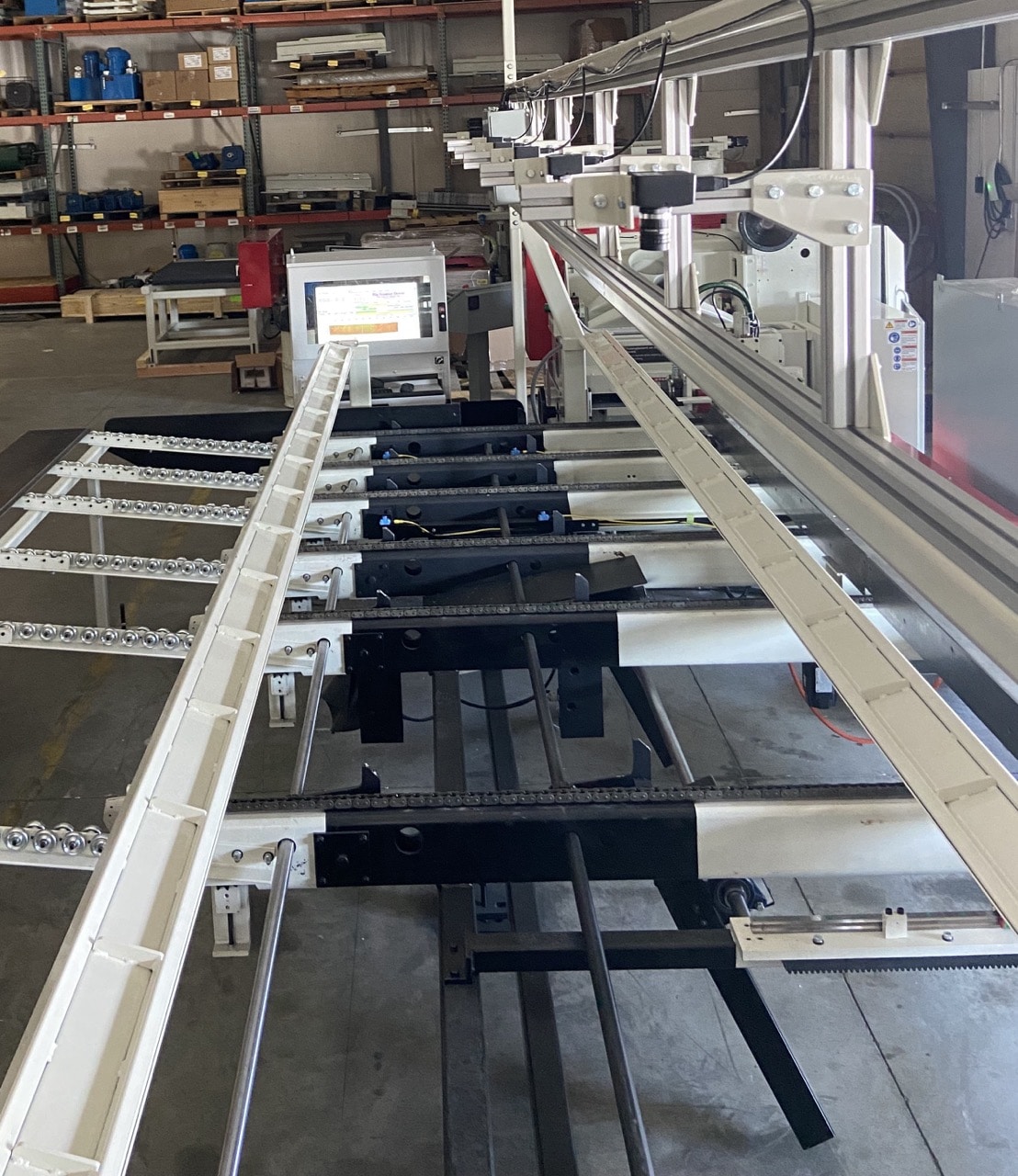
NaviVision — Integrated Vision Scanning for Rip Saws & Infeed Systems
NaviVision is Mereen-Johnson’s purpose-built vision scanning system for rip saw operations. Using multiple high-resolution color cameras for single-face board scanning, NaviVision identifies each board’s width, length, crook, wane, knots, and other surface defects as small as ¼ inch — then uses that data to calculate the rip solution that maximizes yield based on either rip width alone or rip width combined with crosscut requirements.
NaviVision integrates with most existing Mereen-Johnson Scout, Group 7, and Barr-Mullin rip saw infeed systems, making it a viable upgrade path for facilities with existing MJ equipment. Detailed reporting on part production, yield, board quality, vendor performance, and shift productivity is included.
Learn more about NaviVision →What Wood Defect Detection Systems Identify
Wood is a natural material, and no two boards are identical. Effective wood defect detection in a production environment requires systems capable of distinguishing actionable defects from the natural grain variation and color differences that are characteristics of the material — not flaws. Mereen-Johnson’s vision scanning systems are designed specifically for wood, and can be configured to detect and classify a wide range of defect types relevant to your product and grading standards:
What Wood Defect Detection Systems Identify
Wood is a natural material, and no two boards are identical. Effective wood defect detection in a production environment requires systems capable of distinguishing actionable defects from the natural grain variation and color differences that are characteristics of the material — not flaws. Mereen-Johnson’s vision scanning systems are designed specifically for wood, and can be configured to detect and classify a wide range of defect types relevant to your product and grading standards:
Natural Wood Defects
- Knots — Open, closed, tight, or loose; classified by size and location relative to part value zones
- Splits & Checks — End or face splits that affect structural integrity or appearance grade
- Wane — Bark or missing wood along board edges
- Crook & Bow — Geometric deviation from straight that affects yield and processing accuracy
- Rot & Stain — Discoloration or decay that affects grade or appearance
- Resin Pockets — Common in softwoods; relevant to appearance and finishing applications
Process-Induced Defects
- Miscut & Positioning Error — Off-spec cuts detectable before they move downstream
- Surface Tear-Out & Rough Cut — Indicators of tool wear or incorrect feed rate that affect surface quality
- Dimensional Deviation — Width, length, or thickness variation outside tolerance
- Machine Marks & Snipe — Processing artifacts that affect finished product appearance
Vision Scanning & Inspection Applications in Wood Manufacturing
Mereen-Johnson’s vision scanning capabilities are applied at multiple points in the woodworking production process — wherever automated wood quality control can improve yield, reduce waste, or eliminate a manual inspection step.
Rip Saw Yield Optimization
The highest-value application for vision scanning in solid wood processing is rip optimization — using real-time wood defect detection data to determine the cut pattern that maximizes the value of each board. NaviVision enables rip solutions based on part dimensions, defect locations, and individual part value requirements, recovering yield that fixed-cut or manual approaches leave behind.
Grade Sorting & Automated Classification
Vision scanning systems can classify boards or components by grade in real time, triggering automated sort decisions that direct product to the correct downstream path — without a manual grading station. This is particularly valuable in flooring, moulding, and appearance-grade lumber operations where grade accuracy directly affects product value and customer satisfaction.
Surface Finish Inspection
For products where surface quality is a primary value driver — finished flooring, primed doors, appearance-grade moulding — vision scanning provides automated inspection of surface finish quality after processing, catching tool-wear artifacts, tear-out, and surface damage before product reaches packaging or shipping.
Process Monitoring & Tool Wear Detection
Vision systems that detect patterns of process-induced defects — consistent surface marks, dimensional drift, or repetitive positioning errors — can signal equipment issues before they cascade into large volumes of off-spec product. This predictive quality function complements Mereen-Johnson’s remote monitoring capabilities to keep your lines producing within specification.
Integration with Robotic Stacking & Sorting
When connected to Mereen-Johnson’s automated stacking and robotic material handling systems, vision scanning decisions translate directly into physical sort actions — routing product to the correct stack, diverting rejects, or flagging pieces for manual review, all without adding a human inspection step to the line.
Why Choose Mereen-Johnson for Wood Quality Control & Vision Scanning?
Vision scanning for wood products is fundamentally different from machine vision in other manufacturing contexts. Wood’s natural grain patterns, color variation, surface texture, and dimensional inconsistency create a detection environment that generic vision systems struggle with — they’re tuned for the predictable defects of metals and plastics, not the complex, variable characteristics of natural wood material.
Mereen-Johnson’s vision scanning capabilities are built on over a century of woodworking machinery experience. We understand how wood behaves, how it grades, and what defect characteristics actually matter to your customers and production process — not just what’s detectable by a camera. That domain knowledge is embedded in how our systems are configured, tuned, and integrated.
Our NaviVision system represents years of development specifically for the solid wood processing environment, and our broader vision scanning capabilities are engineered to integrate directly with our rip saws, material handling systems, and robotic automation — delivering a cohesive woodworking quality control architecture rather than a standalone inspection cell that doesn’t talk to the rest of your line.
Ready to Automate Quality Control on Your Production Line?
Whether you’re looking to improve yield on a rip saw line, automate grade sorting, or build a comprehensive woodworking quality control system that integrates with your entire production workflow, Mereen-Johnson has the vision scanning expertise and wood manufacturing knowledge to engineer the right solution. Contact our team to discuss what automated wood defect detection could do for your operation.
Frequently Asked Questions: Wood Inspection & Vision Scanning
Automated wood defect detection uses high-resolution cameras, structured lighting, and image processing software to scan boards, panels, or components as they move through the production line — identifying the location, type, and size of defects in real time. That information is then used to trigger downstream decisions: optimizing cut patterns for maximum yield, routing product to the correct grade stack, flagging pieces for review, or diverting rejects — all without stopping the line or requiring a manual inspection step.
Modern vision scanning systems can identify a wide range of natural defects — including knots, splits, checks, wane, crook, rot, stain, and resin pockets — as well as process-induced issues like surface tear-out, dimensional deviation, machine marks, and positioning errors. The specific defects detected and the grading criteria applied are configured to match your product type, species, and quality standards. Mereen-Johnson’s NaviVision system, for example, detects defects as small as ¼ inch and can be calibrated to your specific part value requirements.
In solid wood rip operations, yield improvement comes from using defect location data to calculate the rip cut pattern that maximizes the value of each board — rather than applying a fixed cut pattern that ignores where defects fall. NaviVision provides rip solutions based on individual board characteristics and part value tables, recovering usable clear material that would otherwise be ripped through or discarded. This yield optimization effect is one of the strongest ROI drivers for vision scanning in a sawmill or rough mill operation.
NaviVision is Mereen-Johnson’s integrated vision scanning system designed for rip saw infeed optimization. It uses multiple color cameras to scan boards for width, length, crook, wane, knots, and surface defects, then calculates the optimal rip solution based on your part requirements. NaviVision is designed to integrate with most existing Mereen-Johnson Scout, Group 7, and Barr-Mullin rip saw infeed systems, making it a viable upgrade for facilities already running MJ equipment.
Yes. Effective woodworking quality control automation requires that the inspection system apply your grading criteria — not generic industry defaults. Mereen-Johnson’s vision scanning systems can be configured to match your specific grade definitions, part value tables, and defect tolerance thresholds, ensuring that automated sort decisions align with how your operation and your customers define quality.
Manual inspection has two fundamental limitations: speed and consistency. A human inspector can’t keep pace with a high-production line without missing defects, and judgment varies between inspectors, between shifts, and across the course of a long workday. Automated wood quality control systems apply the same detection criteria to every piece at full production speed — eliminating the variation that comes with human inspection and freeing your workforce from a tedious, fatiguing task. Research into automated wood inspection systems consistently shows higher classification accuracy rates compared to manual inspection, particularly for subtle or small defects.
Yes — and this integration is one of the most powerful aspects of building inspection into a Mereen-Johnson automation system. Because our vision scanning capabilities are designed alongside our robotic stacking, de-stacking, and material handling systems, scan decisions can directly trigger robotic sort actions: routing acceptable product to production stacks, diverting rejects to a separate area, or separating grades for downstream handling — all in a single automated workflow with no manual handoff required.
Mereen-Johnson’s vision scanning systems capture detailed production data including defect frequency and type, yield by board, vendor, species, or shift, part production counts, and quality trend reporting over time. This data supports better decisions about raw material purchasing, production scheduling, and maintenance — and provides the documentation needed to hold suppliers accountable for incoming material quality. NaviVision includes built-in reporting for part production, yield, board quality, vendor performance, and shift productivity.