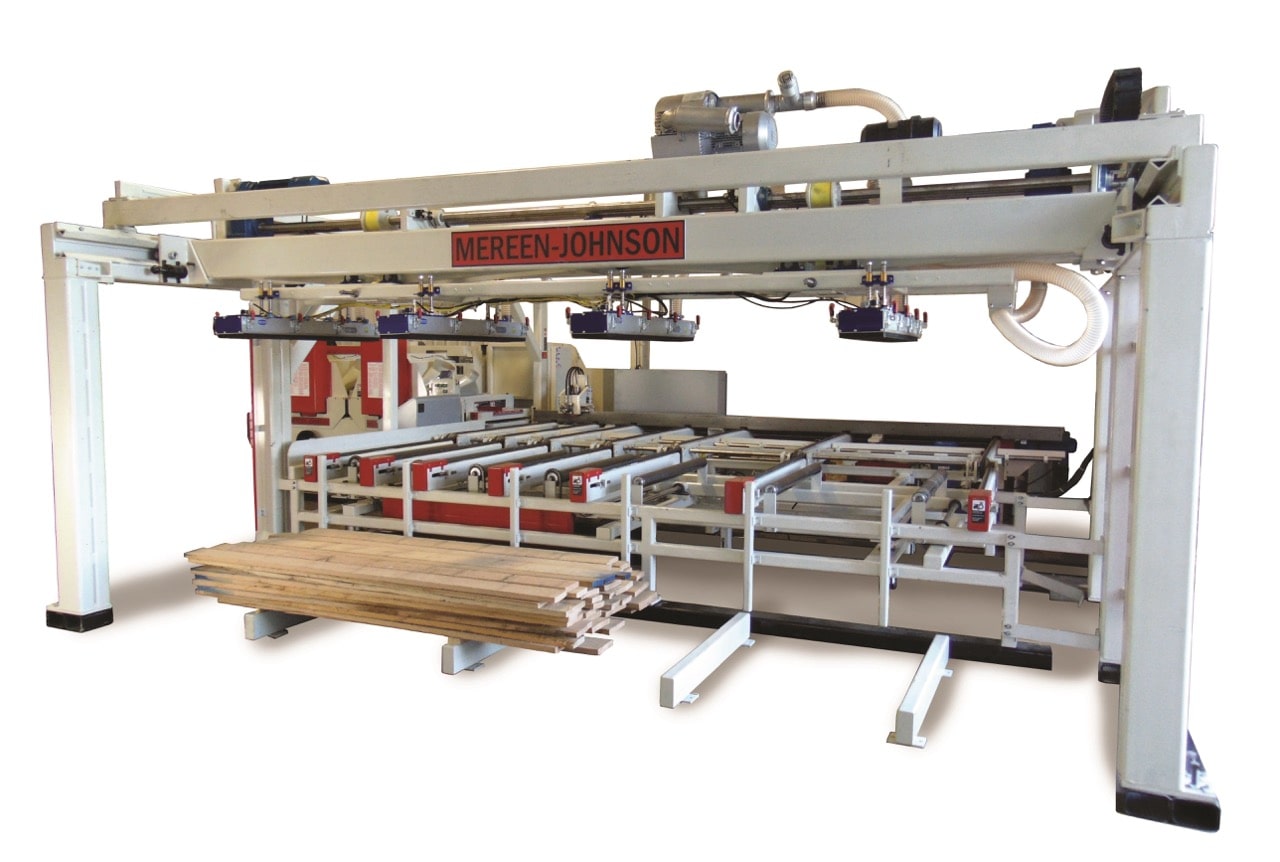
Machine Tending
Automate the Repetitive. Elevate Your Productivity.
In industrial woodworking, machine tending involves the critical yet repetitive tasks of loading and unloading materials, changing tools, performing routine maintenance, and managing part transitions at saws, tenoners, moulders, dovetailers, door sizers, and other processing equipment. These manual operations often create bottlenecks, increase downtime, and tie up skilled labor that could be better utilized elsewhere.
Mereen-Johnson delivers advanced robotic machine tending systems custom-engineered for the woodworking industry. Our solutions automate these essential functions, allowing your team to focus on higher-value tasks such as quality control, process optimization, and production planning.
Key Benefits of Mereen-Johnson Machine Tending Automation
- Increased Productivity — Achieve consistent cycle times and higher throughput, even during unattended or lights-out shifts.
- Reduced Downtime — Minimize operator-dependent interruptions with reliable robotic handling of material loading, unloading, and tool interactions.
- Labor Optimization — Free your workforce from repetitive, physically demanding work, addressing skilled labor shortages while improving job satisfaction and safety.
- Unparalleled Precision — Robotic machine tending systems ensure accurate part placement, orientation, and sequencing, reducing errors and material waste.
- Seamless Integration — Designed and built in-house by the same engineering team that creates your core woodworking machines, ensuring perfect compatibility — no awkward retrofits.
Tailored Robotic Machine Tending Applications for Wood Manufacturing
Our flexible, woodworking-specific machine tending automation solutions include:
Material Loading & Unloading
Precise robotic handling of boards, panels, doors, or components into and out of machines like rip saws, tenoners, moulders, and sizing equipment — maintaining consistent feed rates and part positioning across every production cycle.
Tool Changes & Setup Assistance
Automated routines for tool swapping and machine reconfiguration reduce changeover time in high-mix production environments, minimizing both downtime and the risk of manual setup errors.
Hot Swap & Continuous Feed Solutions
Specialized systems such as our Short Board Hot Swap solution keep material flowing with minimal interruption in high-speed lines — even when stock dimensions or part sequences change mid-run.
CNC Dovetailer & Joinery Machine Tending
Robotic tending for CNC dovetailers and similar joinery equipment maintains tight tolerances on complex parts through consistent loading position and smooth, cycle-to-cycle material transitions — critical in cabinetry and furniture manufacturing where joint fit is unforgiving.
Flexible Long Board & Custom Part Handling
Custom end-of-arm tooling and vision guidance accommodate irregular shapes, long stock, or varied millwork components — purpose-engineered to handle the natural variability of real wood production environments.
Lights-Out Machine Tending Operation
Fully automated machine tending for extended run times without operator intervention — ideal for door sizing lines, furniture components, moulding production, and any application where consistent overnight or weekend throughput creates a competitive advantage.
Why Choose Mereen-Johnson for Robotic Machine Tending?
With over a century of woodworking machinery expertise combined with in-house robotic engineering, controls programming, and large-scale fabrication capabilities, Mereen-Johnson provides turnkey machine tending automation solutions that go well beyond off-the-shelf robotics.
From initial research and design through fabrication, installation, integration, customized workforce training, and ongoing remote monitoring and troubleshooting — we partner with you for long-term success. As authorized dealers for FANUC, Kawasaki, and Stäubli, we select the right robot for each application rather than defaulting to a single platform. Controls are engineered on Allen Bradley/Rockwell Automation systems — industry-standard, field-serviceable, and familiar to most maintenance teams.
Our automated machine tending systems also harness real-time production data for predictive maintenance, performance analytics, and continuous improvement — transforming machine tending from a daily labor challenge into a measurable competitive advantage.
Ready to Automate Machine Tending in Your Facility?
Whether you’re tending a single machine or re-engineering an entire production cell, Mereen-Johnson has the woodworking knowledge and robotic automation capabilities to build a solution that fits your operation — not the other way around. Contact our team to discuss a custom machine tending solution tailored to your facility.
Frequently Asked Questions: Machine Tending Automation
Machine tending automation uses robotic systems to handle the repetitive tasks that keep production equipment running — loading raw material, unloading finished pieces, repositioning parts between operations, and watching for process deviations. In a woodworking facility, this means robots can manage the infeed and outfeed of rip saws, CNC dovetailers, door sizing lines, tenoners, moulders, and other equipment, keeping machines running at full capacity without requiring a dedicated operator at every station.
In many cases, yes. Mereen-Johnson evaluates retrofit feasibility as part of the initial discovery process, considering machine type, control system compatibility, and available floor space. Our engineering team will assess your specific equipment before recommending a solution.
Any high-repetition operation where material loading, unloading, or part handling creates a bottleneck or requires a dedicated operator is a potential candidate. Common Mereen-Johnson machine tending applications include rip saw infeed and outfeed, CNC dovetailer loading, door sizing line automation, tenoner and moulder feeding, and equalizer handling. We evaluate each application individually to confirm that automation will deliver a clear return before recommending a system.
Lights-out operation means a machine tending system runs production without any operator present — typically during overnight or weekend shifts. It requires robust sensing, reliable fault detection, and consistent incoming material. Mereen-Johnson designs certain machine tending systems specifically for lights-out capability, and we assess whether your application and material flow are good candidates during the scoping phase.
Robotic machine tending directly reduces the number of operators needed to keep production machines staffed and running — a critical advantage when trained floor workers are hard to find and retain. Rather than running lines shorthanded or at reduced capacity, facilities with automated machine tending can maintain or increase throughput with the same headcount, while redeploying workers to higher-skill roles like quality control, maintenance, and process management.
Mereen-Johnson is an authorized dealer for FANUC, Kawasaki, and Stäubli, and also works with Yaskawa. Rather than defaulting to a single platform, we select the robot that best fits each application based on payload, reach, speed, precision, and serviceability. The goal is matching the robot to the task — not the other way around.
Timelines depend on system complexity and the degree of customization required. Because Mereen-Johnson handles engineering, fabrication, and robot programming in-house, we avoid the handoff delays common with multi-vendor integrations. Robots are programmed and tested at our facility before arriving on your floor, minimizing disruption to your production schedule.
Every system we install is backed by customized workforce training, remote monitoring and diagnostics, and ongoing technical support. Controls are built on Allen Bradley/Rockwell Automation platforms — widely serviceable systems your maintenance team can work with confidently. We remain available for troubleshooting, software updates, parts, and on-site service as your operation grows and evolves.