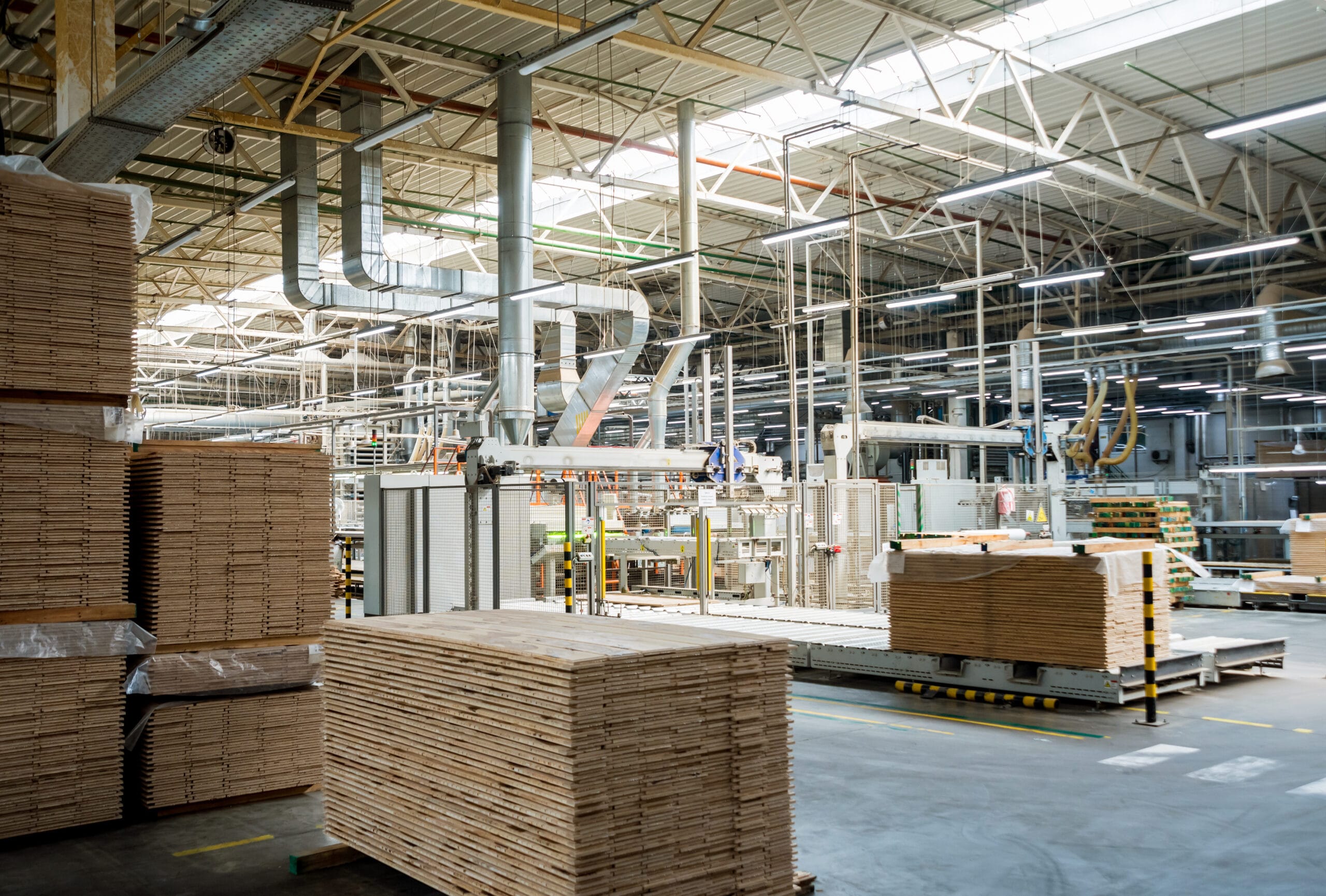
Palletizing Automation
Precision End-of-Line Automation. From Your Production Floor to the Loading Dock.
After your wood products have been cut, sized, shaped, and finished, they still need to make it off the production floor and onto a truck. For most high-volume woodworking facilities, that last step — building stable, shippable pallets from finished lumber, panels, doors, flooring, or components — is done manually, by workers stacking heavy product hour after hour. It’s slow, physically punishing, and one of the hardest positions in the plant to keep consistently staffed.
Mereen-Johnson engineers custom robotic palletizer systems purpose-built for the woodworking industry. Our automated palletizing systems take over end-of-line handling with speed, consistency, and precision — building properly configured pallet loads that meet your shipping and logistics requirements, without the labor overhead and injury exposure of manual palletizing.
Key Benefits of Robotic Palletizing Automation in Wood Manufacturing
- Maximized Throughput — An industrial palletizer never fatigues, slows down, or calls in sick. Consistent cycle times at the end of the line mean upstream production capacity is never bottlenecked by the palletizing operation.
- Reduced Labor Costs — Manual palletizing typically requires dedicated headcount on every shift. Palletizing automation eliminates that dependency — freeing your workforce for higher-value roles and reducing overall labor cost per unit.
- Fewer Injuries, Lower Risk — Repetitive heavy lifting at end-of-line is one of the most injury-prone tasks in a wood manufacturing facility. A robotic palletizer removes workers from this exposure entirely, reducing workers’ compensation claims and improving floor safety culture.
- Stable, Consistent Pallet Loads — Robotic palletizing builds uniform, stable loads every time — reducing product damage in transit, improving load efficiency, and meeting the dimensional and weight requirements of downstream logistics partners.
- Flexible Pattern Programming — Palletizing machines can be programmed for multiple pallet configurations and product types, with pattern changes executed quickly via HMI — no mechanical retooling required.
- Seamless Production Line Integration — Designed and built in-house by the same Mereen-Johnson engineers who know your woodworking machinery, our palletizing systems integrate cleanly with your existing conveying, stacking, and processing equipment.
Robotic Palletizer Applications for Wood Products
Wood products present specific palletizing challenges that generalist automation integrators are rarely equipped to address — variable board lengths, surface finish sensitivity, mixed-dimension product runs, and the weight of solid lumber all demand purpose-engineered solutions. Mereen-Johnson’s automated palletizing systems are designed around the actual materials and workflows of high-production woodworking facilities.
Lumber & Dimensional Wood Palletizing
Robotic palletizing of boards and dimensional lumber requires end-of-arm tooling designed for the length, weight, and surface characteristics of wood stock — and pallet patterns configured for load stability with products that shift, bow, or vary slightly in dimension. Our palletizing machines handle these demands reliably, building stable unit loads ready for banding, wrapping, and shipment.
Door & Panel Palletizing
Finished doors, door blanks, and large wood panels require careful handling to avoid surface damage — scratching, denting, or marring a pre-finished or primed surface at the last step of production is a costly mistake. Mereen-Johnson’s robotic palletizing systems use custom tooling designed for surface-sensitive product handling, placing each piece gently and precisely into the required pallet configuration.
Flooring & Moulding Component Palletizing
High-volume flooring and moulding production lines generate large quantities of finished strips and profiles that must be collected, organized, and palletized quickly to keep pace with upstream processing speeds. Our industrial palletizer solutions are engineered to handle the throughput demands of these fast-running lines without becoming the bottleneck at the end of the process.
Cabinetry & Furniture Component Palletizing
Cabinet doors, drawer fronts, furniture parts, and other machined components often require precise orientation and layered pallet configurations to prevent contact damage and ensure components arrive at the next destination — whether an assembly line or a customer — in perfect condition. Our automated palletizing systems accommodate the mix of part sizes and handling requirements common in cabinetry and furniture manufacturing.
Mixed-Product & High-Mix Palletizing
Facilities running multiple product lines, SKUs, or species mixes benefit significantly from the programmability of robotic palletizing. Pattern changes, layer configurations, and product changeovers can be executed via HMI without stopping the line for mechanical adjustments — keeping production moving through product transitions.
Why Choose Mereen-Johnson for Industrial Palletizing Automation?
There’s no shortage of companies that sell robotic palletizers. Most of them are generalists — experienced with boxes, bags, and consumer packaged goods, but without deep knowledge of how a woodworking production line operates, how wood products behave, or what end-of-line handling means in the context of a door plant, a flooring mill, or a cabinet component facility.
Mereen-Johnson brings something different: over a century of woodworking machinery expertise, combined with in-house robotic engineering, controls programming, and large-scale fabrication capabilities. When we design a palletizing automation system for a wood products manufacturer, we’re building on first-hand knowledge of your upstream equipment, your material characteristics, and your production workflow — not adapting a system developed for a different industry.
Our palletizing machines are engineered, fabricated, and programmed entirely in-house. Controls are built on Allen Bradley/Rockwell Automation platforms — serviceable, field-supported systems that integrate cleanly with the rest of your operation. We work with FANUC, Kawasaki, and Stäubli robots, selecting the right platform for each application’s payload, speed, and reach requirements. And because we’re a long-term partner — not a project-and-move-on integrator — we provide training, remote monitoring, and ongoing support for every system we install.
Ready to Automate End-of-Line Palletizing in Your Facility?
Whether you’re building pallets from dimensional lumber, finished doors, flooring strips, or furniture components, Mereen-Johnson has the woodworking knowledge and palletizing automation expertise to engineer a system that keeps pace with your production line and your logistics requirements. Contact our team to discuss a custom robotic palletizer solution designed for your operation.
Frequently Asked Questions: Robotic Palletizing for Wood Manufacturing
A robotic palletizer is an industrial palletizer system that uses a programmable robotic arm to pick finished products from a conveyor or collection point and place them onto a pallet in a specified pattern and configuration. In a woodworking facility, this typically means building pallet loads of lumber, panels, doors, flooring, or machined components at the end of a production line — replacing the manual labor of a worker stacking product by hand across every shift. The robot executes the same pallet pattern consistently, at a defined cycle rate, without fatigue or variation.
Mereen-Johnson’s automated palletizing systems are engineered to handle the range of products common in high-production wood manufacturing — including dimensional lumber, door blanks and finished doors, flooring strips and profiles, wood panels, moulding, and machined cabinetry or furniture components. System design, including end-of-arm tooling and pallet pattern configuration, is tailored to the specific dimensions, weight, and surface requirements of your product mix.
Surface finish protection is a key design consideration for any palletizing machine handling finished wood products. Mereen-Johnson engineers custom end-of-arm tooling suited to the surface characteristics of your specific product — using appropriate vacuum, gripper, or cushioned contact designs that place and release parts gently without marring pre-finished or primed surfaces. Pallet layering and interleaving configurations can also be programmed to prevent contact damage between stacked pieces.
Yes. One of the core advantages of robotic palletizing automation over conventional mechanical palletizers is programmability. Pattern configurations, layer counts, product orientations, and pallet dimensions can all be stored as recipes and called up via HMI — allowing your team to switch between product types or pallet specifications quickly without mechanical retooling. This flexibility is particularly valuable in facilities running mixed product lines or multiple SKUs.
Conventional palletizing machines use fixed mechanical systems — pushers, formers, and layer-building mechanisms — that are fast and reliable for high-volume, single-product applications but limited in flexibility. Robotic palletizers use a programmable arm that can be reconfigured in software for different products, patterns, and pallet types. For wood products manufacturers running varied product mixes or frequent product changeovers, robotic palletizing typically offers better flexibility and a smaller floor footprint, while conventional systems may be preferred in very high-speed, single-SKU applications.
End-of-line palletizing is physically demanding, repetitive work that is increasingly difficult to staff reliably — especially across multiple shifts. An automatic palletizer machine eliminates that staffing dependency at one of the highest-turnover positions on the floor. Rather than running shorthanded at the end of the line and letting upstream production stack up, facilities with palletizing automation maintain consistent throughput to the dock regardless of daily staffing conditions.
Mereen-Johnson is an authorized dealer for FANUC, Kawasaki, and Stäubli, and also works with Yaskawa. For palletizing applications, robot selection is driven by the payload capacity required for your product weight, the reach needed for your pallet configuration, and the cycle speed demanded by your production rate. We select the right robot for each specific application rather than defaulting to a single platform.
Yes — and this is one of Mereen-Johnson’s core strengths. Because our automation team designs the full range of production line automation including conveying, stacking, de-stacking, and vision scanning, we can integrate automated palletizing systems into a complete, cohesive end-to-end workflow rather than adding a standalone cell that doesn’t communicate well with what’s upstream. All systems use Allen Bradley/Rockwell Automation controls, ensuring consistent integration architecture throughout the line.