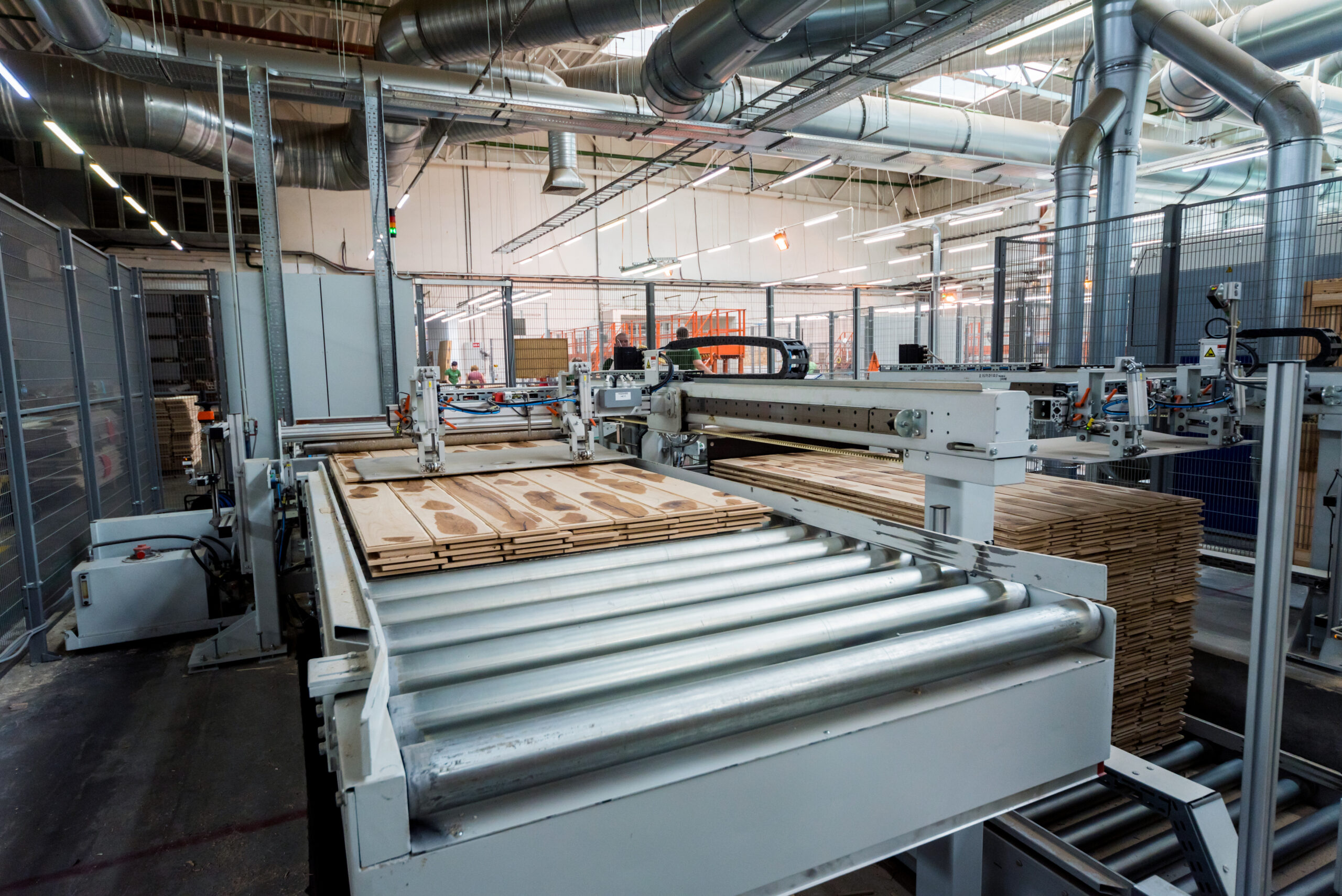
Wood Conveying System
Move Material Smarter. Connect Every Step of Your Production Line.
A woodworking production line is only as efficient as its weakest link — and for many high-volume facilities, that weak link isn’t the machinery. It’s the space between machines. When boards, panels, components, or finished products have to be moved manually from one operation to the next, the result is a patchwork of bottlenecks, pace mismatches, and labor costs that accumulate across every shift.
Mereen-Johnson engineers custom wood conveyor systems that tie your production line together — moving raw material to machines, work-in-progress between operations, and finished goods toward packaging, palletizing, or shipment. Our wood conveying systems are designed and built in-house as part of a cohesive automation architecture, not sourced from a catalog and bolted on. The result is material flow that keeps pace with your equipment, your throughput goals, and your floor layout — from the first board in to the last pallet out.
Key Benefits of Custom Wood Conveyor Systems
- Eliminate Between-Machine Bottlenecks — Every gap in automated material flow is a potential pileup or pace mismatch. Custom wood conveying systems close those gaps, keeping material moving at the rate your processing equipment demands.
- Reduce Touch Labor — Manual transport between operations is one of the most persistent and invisible sources of labor cost in a woodworking facility. Automated conveying systems eliminate that overhead and redeploy workers to higher-value tasks.
- Improve Safety — Manual material handling — lifting, carrying, and repositioning heavy lumber or panels — is a primary source of workplace injuries. Conveying systems remove workers from repetitive transport tasks, reducing exposure to lifting-related strain and forklift interaction.
- Support Consistent Production Pace — A well-designed conveying system feeds each machine at the right rate and in the right orientation, enabling your equipment to run at its designed throughput without over-accumulation or starvation at the infeed.
- Enable Integrated Automation — Wood conveyor systems are the connective tissue of a fully automated production line. They link machine tending, stacking, vision scanning, and palletizing into a single continuous workflow rather than a series of disconnected operations.
- Built for the Woodworking Environment — Dust, debris, variable board dimensions, and the specific weight and surface characteristics of wood products all factor into how a conveying system must be designed. Mereen-Johnson builds for this environment — not around it.
Wood Conveying System Types & Applications
As a custom wood conveyor manufacturer, Mereen-Johnson designs conveying solutions for every stage of the woodworking production process. The right conveying approach depends on your material type, machine speeds, floor layout, and production goals. Our engineering team evaluates all of these factors before specifying a system.
Infeed Conveyor Systems
Infeed wood conveying systems deliver raw boards, blanks, or panels to a processing machine at the correct feed rate, orientation, and position — eliminating the manual feeding step and ensuring the machine receives consistent material at its designed input rate. Mereen-Johnson infeed systems are engineered to work in sync with specific machines, whether that’s a rip saw, moulder, tenoner, dovetailer, or sizing line, matching feed speed and staging requirements precisely.
Outfeed Conveyor Systems
Outfeed conveyors receive processed material as it exits a machine and transfer it to the next stage — whether that’s a downstream operation, a vision scanning station, a stacking system, or a staging area. Properly designed outfeed systems prevent accumulation at the machine exit, maintain part orientation, and keep the production line moving without manual intervention between operations.
Transfer & Cross-Transfer Systems
In multi-machine or multi-line facilities, transfer conveyors route material laterally, reorient parts, or divert product to different downstream paths based on product type, grade, or production sequence. Mereen-Johnson transfer systems handle 90-degree turns, lane changes, and directional transitions — enabling complex production routing without manual repositioning or forklift involvement.
Accumulation & Buffer Conveying
When different operations run at different cycle times, accumulation conveyor sections act as intelligent buffers — absorbing the pace difference between a fast upstream machine and a slower downstream one without stopping the line. This decoupling function is critical in multi-step production environments where takt time mismatches between operations would otherwise create cascading bottlenecks.
Between-Operation Material Flow
In fully integrated production lines, conveying systems serve as the connective infrastructure between every automated function — linking machine tending cells, vision scanning stations, stacking and de-stacking systems, and end-of-line palletizing into a continuous, automated workflow. Mereen-Johnson designs these integrated wood conveying systems as a complete architecture, ensuring every section communicates with and supports the operations around it.
Conveying as the Foundation of Full-Line Woodworking Automation
In isolation, each piece of automation on a woodworking production floor solves a specific problem. A robotic machine tender eliminates manual infeed labor. A vision scanning system improves yield. A robotic palletizer handles end-of-line product building. But without a well-designed wood conveyor system connecting them, these capabilities remain islands — and the space between them remains manual, slow, and dependent on headcount.
Mereen-Johnson designs conveying as an integral part of the overall automation architecture — not as an afterthought. Because our engineering team develops the full range of automation systems for woodworking production lines, we understand how conveying must behave at every interface: the precise feed rate a rip saw demands, the orientation requirements of a dovetailer infeed, the accumulation logic needed to balance a vision scanning station with a downstream stacking cell.
The result is a wood conveying system that doesn’t just move material — it orchestrates the entire production flow.
Why Choose Mereen-Johnson as Your Wood Conveyor Manufacturer?
There is no shortage of conveyor manufacturers in the market. What distinguishes Mereen-Johnson is not just the ability to build a wood conveyor system — it’s the ability to build one that’s engineered around the exact machinery it’s feeding, the specific material it’s handling, and the broader automation workflow it’s part of.
Our mechanical engineering team designs conveying systems in SolidWorks and AutoCAD, with electrical controls on Allen Bradley/Rockwell Automation platforms that integrate seamlessly with the rest of your line. Because we build the woodworking machines, the robotic systems, and the conveying infrastructure under one roof, the communication between them is precise — not approximate.
More than a century of woodworking machinery experience means we understand what wood production environments demand: the dust and debris management requirements, the board dimension variability, the speed matching between a fast rip saw and a downstream operation, the surface protection needs of finished product. These aren’t generic conveying problems — they’re woodworking-specific engineering challenges, and they’re ones Mereen-Johnson is specifically equipped to solve.
Ready to Connect Your Production Line with Custom Wood Conveying Systems?
Whether you need a single infeed system for a specific machine or a fully integrated material flow architecture across your entire facility, Mereen-Johnson has the woodworking expertise and custom engineering capabilities to build it. Contact our team to discuss a wood conveyor system designed around your equipment, your material, and your production goals.
Frequently Asked Questions: Wood Conveyor Systems & Conveying Automation
Yes — “conveyer” and “conveyor” are two spellings of the same word, with “conveyor” being the more widely used technical spelling in industrial and manufacturing contexts. Both terms refer to the same equipment: systems that move material along a defined path through a production facility. Whether you’re searching for wood conveyers, wood conveyor systems, or wood conveying systems, Mereen-Johnson engineers and builds all of these solutions for high-production woodworking facilities.
Mereen-Johnson designs and builds custom wood conveying systems for every stage of the woodworking production process — including infeed systems that deliver material to processing machines, outfeed systems that transfer product to the next operation, transfer and cross-transfer systems for lane changes and directional routing, accumulation and buffer systems that manage pace differences between operations, and fully integrated material flow architectures that connect multiple machines and automation systems into a continuous production workflow.
Off-the-shelf conveyor systems are designed to general specifications — they move material, but they’re not engineered around a specific machine’s feed rate, a specific board’s dimensional characteristics, or a specific facility’s floor layout. Mereen-Johnson’s wood conveyor systems are custom-engineered to the exact requirements of each application — designed by the same team that builds the woodworking machinery the conveyor is feeding. This means feed rates, part orientation, accumulation logic, and integration with adjacent automation systems are all specified precisely, not approximated.
Yes — and this is one of the core engineering challenges that distinguishes wood conveying from other material handling contexts. Boards vary in width, length, thickness, and straightness, and a conveying system must accommodate that variability without jamming, misaligning parts, or damaging material. Mereen-Johnson designs for this inherent variability, building in the adjustability, sensing, and mechanical tolerances needed to handle the range of dimensions your production actually runs — not just the nominal spec.
Yes — in fact, conveying is what makes these systems function as a unified production line rather than a collection of individual automation cells. Mereen-Johnson designs conveying infrastructure as the connective layer between machine tending, vision scanning, stacking, and palletizing systems, ensuring that material transitions between automated functions smoothly and at the right rate. Because all of our automation systems share the same Allen Bradley/Rockwell controls architecture, integration between conveying and adjacent automation is precise and well-coordinated.
Woodworking environments present specific challenges that generalist conveyor systems aren’t always designed for: sawdust and chip accumulation, heavy and irregular material loads, and the need for surface protection on finished products. Mereen-Johnson’s wood conveying systems are engineered with these conditions in mind — including appropriate debris clearance, materials and finishes suited to the environment, and handling characteristics that protect board surfaces throughout the line.
Yes. Many Mereen-Johnson conveying projects involve integrating new material flow solutions into existing production environments — working around fixed machine positions, structural constraints, and active production schedules. Our engineering team conducts a thorough assessment of your facility layout before designing any conveying system, and installation is planned to minimize disruption to your ongoing operations.
Yes. Like all of our automation systems, wood conveyor systems we install are backed by operator and maintenance training, remote monitoring and diagnostic capabilities, and ongoing technical support. Controls are built on Allen Bradley/Rockwell Automation platforms — industry-standard systems your maintenance team can work on confidently. Parts availability and on-site service are available for the life of the system.